


This is the full-spectrum, director’s cut version of the Application Protection Report, untrammeled by petty concerns like brevity or toner prices (for the shorter version, please see our Summary). This report pulls together the various threats, data sources, and patterns in the episodes into a unified line of inquiry that began in early 2019, picking up where the 2018 Application Protection Report left off, and concluded in early 2020 with updated data on 2019 breaches and architectural risk.
One of the goals of the Application Protection Research Series is to place security trends and patterns into a single long-term picture, to get away from news cycles and hype that only focus on new threats or vulnerabilities that may not even be applicable. This perspective also allows us to see linkages between the different subdomains and foci that make up the complex and porous field we call information security.
One of the underlying themes for the 2019 series has been that changes in the ways that we design, build, and deploy applications have been drivers for risk. From third-party services driving the rise of an injection attack known as formjacking, to a growing list of seemingly avoidable API breaches, to the prevalence of platforms running on languages with old and documented flaws, there has been a good deal of goalpost movement for defenders. The implication is that many of the people who are making decisions with significant ramifications for security—system owners, application architects, DevOps teams—are generally placing other priorities ahead of security. Based on the acceleration of trends in 2019 that we identified from 2018, it seems that this tension will characterize the next few years of the security arms race.
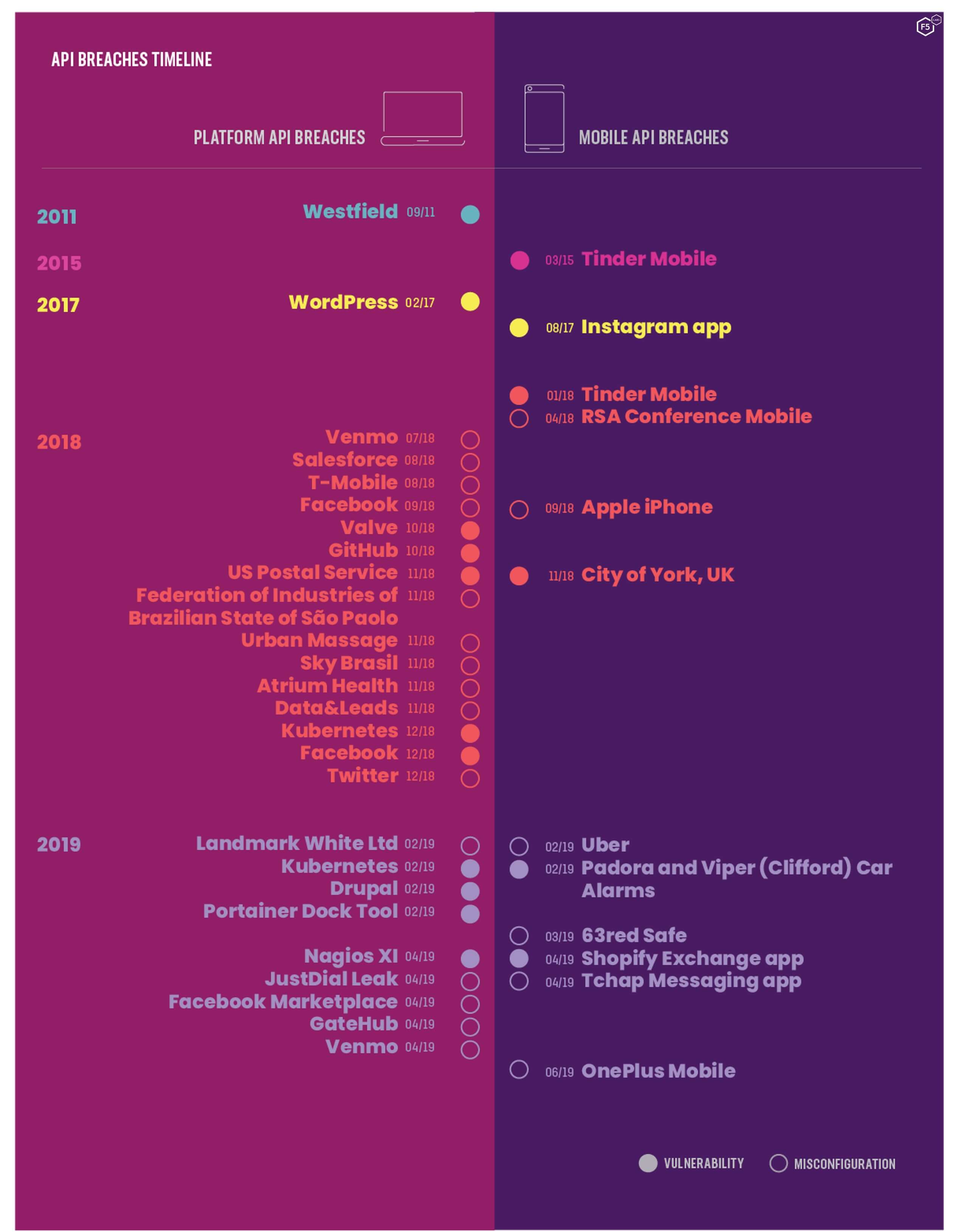
Another theme of the last few years of application security research has been the prominence and great success of access-tier attacks. By this we mean attacks that focus on the intersection between human users and information systems. These attacks can focus on humans, like phishing or other social engineering, or on machines, like credential stuffing and brute force. It can be tempting to look at phishing success rates and conclude that our battle is unwinnable. Instead, we take this as evidence that technical controls are working, and that more straightforward paths to our data have become impassable. It also indicates that there will always be some aspects of the security problem that don’t fit well into the traditional body of security knowledge, and people—squishy, unpredictable, occasionally lovable—will always be the most prominent of these.
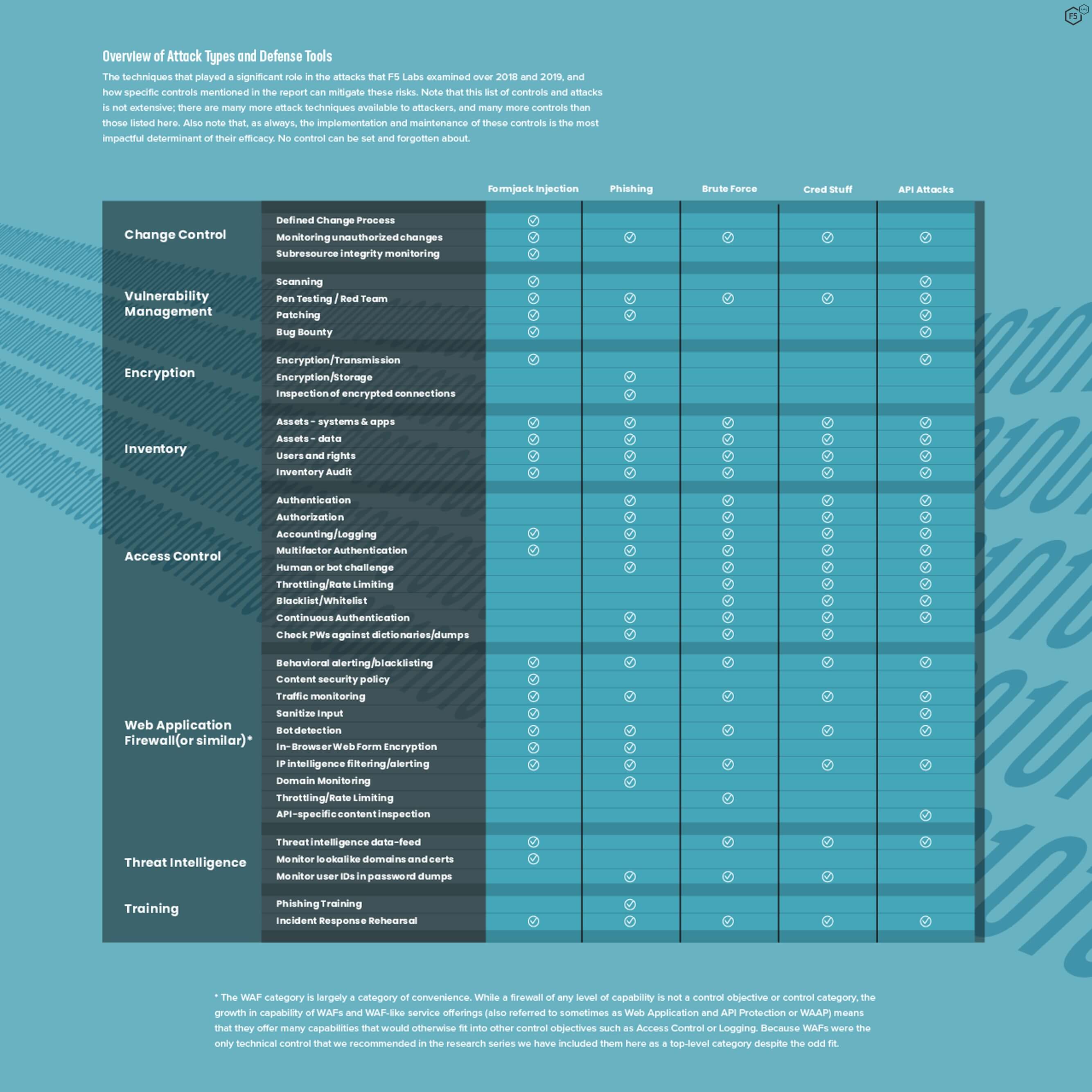
The matrix above, which is also included at the conclusion of the report, shows how different types of controls can help mitigate the specific vectors we’ve identified in this research. At the end of each section, we go into greater detail about how to actually prevent or mitigate some of the attacks we’ve documented here. After all, a report called Application Protection wouldn’t be any use if it didn’t help protect any applications. As you read the report and consider our findings, recommendations, and predictions for the future, we ask three things:
Think on how our work resonates with your own experience in your own systems
Consider what questions and follow-up research this report provokes for you
Share those thoughts and questions with us for future work
Our line of work demands communication and collaboration, and F5 Labs’ sole mission is to put useful information in the hands of defenders—tell us how we can help!
About the authors

Raymond Pompon
Director of F5 Labs | F5
Raymond Pompon was the Director of F5 Labs. With over 20 years of experience in Internet security, he has worked closely with federal law enforcement in cyber-crime investigations. He was directly involved in several major intrusion cases, including the FBI undercover Flyhook operation and the NW Hospital botnet prosecution. He is the author of IT Security Risk Control Management: An Audit Preparation Plan published by Apress books.
More research by Raymond Pompon
Sander Vinberg
Threat Research Evangelist, F5 Labs | F5
Sander Vinberg is a Threat Research Evangelist for F5 Labs. As the lead researcher on the Application Protection Research Series, he specializes in the evolution of the threat landscape over the long term. He holds a master’s degree from the University of Washington in Information Management, as well as bachelor’s degrees in History and African and African-American Studies from the University of Chicago.
More research by Sander Vinberg
Sara Boddy
Threat Researcher | F5
Sara Boddy was a Senior Director overseeing F5 Labs and Communities. She came to F5 from Demand Media where she was the Vice President of Information Security and Business Intelligence. Sara ran the security team at Demand Media for 6 years; prior to Demand Media, she held various roles in the information security community over 11 years at Network Computing Architects and Conjungi Networks.
More research by Sara Boddy
Debbie Walkowski
Security Threat Researcher | F5
As a Security Threat Researcher for F5 Labs, Debbie specialized in writing threat-related educational content as well as blogs, articles, and comprehensive research reports about application threat intelligence. She had worked for F5 for 10 years and has more than 20 years’ experience in the technology industry as a technical writer. She holds SANS GIAC Information Security Professional (GISP), GIAC Security Essentials (GSEC), and GIAC Security Fundamentals (GISF) certifications. Her bachelor’s degree from the University of Washington is in scientific and technical communication with an emphasis in computer science. She is the author of 18 technology books published by IDG Books, SAMS, QUE, and Alpha Books.
More research by Debbie Walkowski
David Warburton
Director, F5 Labs | F5
David Warburton is director of F5 Labs. He has worked in the IT industry for over 20 years, starting life as a full stack developer before wrangling with the perils of cloud architecture and then moving the serene and peaceful life of cyber security. His research covers a wide range of topics from the deeply technical, such as cryptography, to the more real-world sociotechnical side of security. Warburton has given talks around world for Infosec (UK), GovWare (Singapore), Crikeycon (Australia), ITBN (Hungary), Digital Transformation EXPO (UK) and for the UK military. Warburton has made dozens of international media appearances on TV, print and industry podcasts, including BBC World News, Sky News, SABC, The Guardian and Risky Business. He is the author of F5 Labs publications including the annual ‘Phishing and Fraud’ and ‘TLS Telemetry’ reports, and recently he co-authored the SSL/TLS/HTTPS scanning devops tool ‘Cryptonice’ which helps organisations improve their application security posture. Warburton was awarded a Masters in Information Security from Royal Holloway University of London where his thesis was on the use of security and cryptography in internet-of-things (IoT).
More research by David Warburton